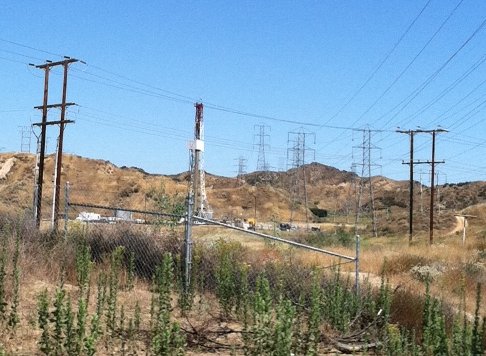
A reader sends in a spy shot of one of the structures in the hills north of Newhall Ranch Road thought to be part of a natural gas hydraulic fracturing operation:
After thinking about this some more and reading all your responses to our initial story on this, I’m struck by how useful and productive our land is in the SCV from a capitalist perspective. Let’s review all the ways in which the land in the SCV has been productive:
First it was used as ranching territory after Henry Mayo Newhall bought it. To some extent, it’s still used in that way, cows still roam land on the Rancho. They may not for long, if Newhall Ranch is built.
Then, at the beginning of the oil boom, folks down in Pico Canyon managed to stand up an oil well and tap crude. An oil refinery followed in what was then the “Newhall Saugus” area. Wealth, for a little while, flowed from the ground.
Then in the early to mid 20th century, the land was used for farming. As SCV old timers remember, onion fields and other produce was grown all over the place. For a long time, this made up the core of the pater familias’ business interests. In some areas, you can still see how the land is used in this way.
Finally, in the 1960s, the land underwent massive change as entire communities were built. I suppose someone, somewhere, at some time determined the land would be even more productive if it held houses rather than patches of agriculture. Their decision to do this was no doubt based in part on the availability of cheap oil extracted from land elsewhere in the world.That continued for decades, a city was born, and voila! 250,000 people live here.
And there was one other productive use of the land: throughout these periods, land in the SCV was and continues to be used for shooting films, television and advertisements.
But now today, someone (Newhall Land?) is benefiting from materials beneath the land again by using the latest technology, hydraulic fracturing. Here’s how that economic model works according to Geology.com:
Mineral rights also include the rights to any oil and natural gas that exist beneath a property. The rights to these commodities can be sold or leased to others. In most cases, oil and gas rights are leased. The lessee is usually uncertain if oil or gas will be found so they generally prefer to pay a small amount for a lease rather than pay a larger amount to purchase. A lease gives the lessee a right to test the property by drilling and other methods. If drilling discovers oil or gas of marketable quantity and quality it may be produced directly from the exploratory well.
This isn’t a unique story (or even a very interesting one) but it shows that even though the housing market has gone bust and the SCV is nearly built-out, enterprising people will find other productive ways to use our land. And make no mistake about it, whoever owns this land is getting a cut of the fracking operation, of whatever gas is being extracted from the ground.
I wish the Signal would do some more reporting on this. Who owns the land? Is it really a hydraulic fracking operation? What’s the regulatory approval process for this in California? What chemicals are they using in their operation? Can we expect more of these types of operations on land in the SCV that is difficult to build on? What’s the City’s take on this, do they view this as economic development that should be encouraged?
Comments
2 · as published