
Two readers responded to my claim that AE may be exclusionary.
Another (my previous comments are in italics):
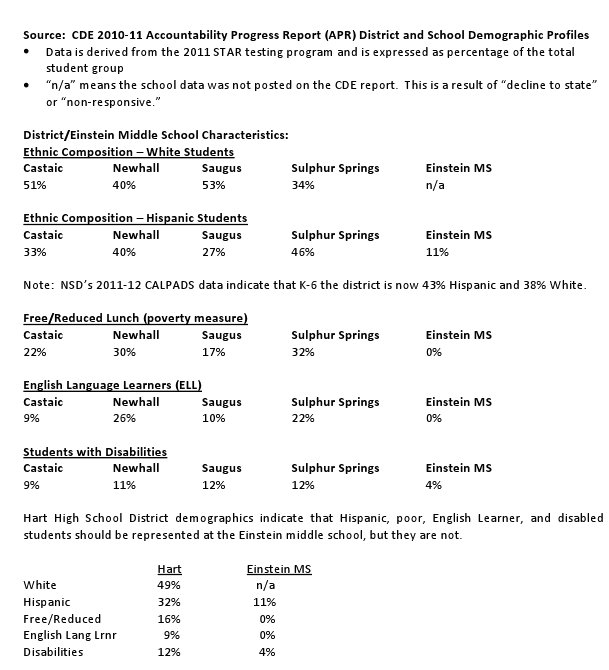
It should be fairly simple to look at the makeup of a charter school student body and compare it to a traditional public school to see if the charter is exclusionary. That's exactly what. Dr. Winger at Newhall did in his comments before the LA County Office of Education board when Einstein appealed there the last time. Here's what he found:
What's more, when AE appealed to the LACOE Board last year, the Board found that AE would ask parents "for a $2,500 donation per student per year." If that's not exclusionary, I don't know what is. The Board said that "parents who cannot afford to pay $2,500 may be discouraged from enrolling their children in the school." Take a look at the board's 22 page summary of the deficiencies in Einstein's petition.
I hope this suggested donation has changed this year (the URL cited by the report returns a 401 - Not Found error on the Einstein website), but the reader will note the similarity of this donation suggestion to the story we linked to last week about boutique charter schools pressuring parents for donations.
The West Creek Academy is another example of a traditional public school that is innovating with its emphasis on the arts and music.
Our local school districts are continuing to perform despite several years of budget cuts. They're doing more with less, teacher unions and all.
Einstein 1
Einstein 2
-----------------
Albert Einstein reaction, ctd
I understand and share your concerns as far as possibly creating an elitist or divided education system, but I don't believe the reality is that cut and dry. In fact, I believe (and the intent of charter legislation is such) that the introduction of charter schools enhance the traditional system. It's unfortunate that the local districts, who are obviously aware that large numbers of their 'customers' are unsatisfied, seem unwilling or unable to respond by improving or diversify their own offerings. They will come around, they'll have to, but I do find it quite a shame that we're not there yet.
As far as demographics - I hear what you're saying and I can't speak for the other choice schools, but it is not the case at SCVi. The school population is very diverse.
Another (my previous comments are in italics):
You write that AEA is exclusionary.
“A public school. That teaches Hebrew. Who do you think that's going to attract? This is not exclusionary?”
We sent our daughter to AEA for middle school. (We decided to send her to Saugus for High School due to some programs that were available at Saugus but not available at AEA.) We are not Jewish, and she did not take Hebrew. (She took Spanish, and is enrolled in Spanish 2 as a Freshman.) At no time while our daughter was enrolled at AEA did we ever feel excluded or not part of the school because we weren’t Jewish. We were very happy with the education she received at AEA; her recent Star Testing scores show her as advanced in every category. Just because the school offers Hebrew it somehow excludes students who aren’t Jewish? Saugus offers auto shop classes…. Does that mean Saugus exclude students who aren’t interested in car maintenance as a career? I don’t follow your logic here.
“First of all, such schools only attract parents who are actively seeking an alternate education. It's like knowing that there is a secret menu at In 'n Out; unless you know that there's a charter option available to you, you'll never even know you could have tried something different.”
The way I read the above statement is AEA somehow excludes students whose parents don’t bother to take an interest in their kid’s educational future. This logic is similar to those who think grades are unfair. I mean do you think it’s fair that those who study and apply themselves receive better grades then those who don’t? You also mention that only parents who have reached a certain economic level can afford to take the time to look into alternate venues of education for their children. I think this argument is ludicrous – several if not most of AEA students come from families where both parents work full time jobs.
The bottom line is: AEA is free, and can not actively select students based on any criteria other than who signs up first, and then a lottery if the classes fill up. I don’t see how it could be any more fair. The school is available to everybody, if parents choose to not send their kids to AEA they obviously don’t have to. As I mentioned before, we are sending our daughter to Saugus for high school, but we were more than happy with her education at AEA.
It should be fairly simple to look at the makeup of a charter school student body and compare it to a traditional public school to see if the charter is exclusionary. That's exactly what. Dr. Winger at Newhall did in his comments before the LA County Office of Education board when Einstein appealed there the last time. Here's what he found:
We believe we can judge Einstein’s ability and/or willingness to perform on the requirementof the law to increase opportunities for low achieving students, or to reflect this CSBA recommendation, using the demographic characteristics of their current middle school (MS) student body.

What's more, when AE appealed to the LACOE Board last year, the Board found that AE would ask parents "for a $2,500 donation per student per year." If that's not exclusionary, I don't know what is. The Board said that "parents who cannot afford to pay $2,500 may be discouraged from enrolling their children in the school." Take a look at the board's 22 page summary of the deficiencies in Einstein's petition.
I hope this suggested donation has changed this year (the URL cited by the report returns a 401 - Not Found error on the Einstein website), but the reader will note the similarity of this donation suggestion to the story we linked to last week about boutique charter schools pressuring parents for donations.
In my opinion having charter schools available to the community gives us two major benefits. First, I think it introduces some competition into a previous “monopoly” and provides pressure for the existing schools to step up their game. Secondly, it gives alternate venues of education for our kids. We selected AEA primarily because of the smaller class sizes (25 kids per class verses over 30 in middle school.) I think the major opposition to charter schools available comes from teacher’s unions and educators unwilling to innovate or respond to any competition from new schools.But districts like Newhall are doing something right, they are innovating. How do you explain McGrath Elementary, located in one of the poorest areas of the SCV with a student population that is, to be delicate, migratory in nature? Just last year they were one of only 255 schools to receive a National Blue Ribbon.
The West Creek Academy is another example of a traditional public school that is innovating with its emphasis on the arts and music.
Our local school districts are continuing to perform despite several years of budget cuts. They're doing more with less, teacher unions and all.
Einstein 1
Einstein 2
-----------------