I’ve been reading through the Winter 2010 Public Opinion Survey of 500+ Santa Clarita residents commissioned by the City prior to the Council Election. First of all, if you haven’t read it, you should. This thing is a real gem.
Anyway, I keep coming across one complaint again and again: Traffic congestion. According to the participants, traffic congestion is the 4th most important issue facing Santa Clarita, ahead of things like youth drug use and residential development. Towards the end of the survey, respondents were given an opportunity to vocalize their complaints specifically. Here’s one fellow from Valencia on traffic congestion:
Traffic, backed up traffic. Unplanned street improvements or changes.Traffic signals some of them are not timed correctly or they don’t check out how they should betimed. I sat at a traffic light for almost a minute and a half.
Poor baby had to wait at a stop light for almost a minute and a half? Are you (*#($&@# kidding me?
No wonder they’re all so unhappy…with expectations like that, they’re bound to be disappointed!
But surely not everyone can be that unreasonable, can they? And is traffic that bad to begin with?
Let’s find out.
The Test
I decided to test Santa Clarita traffic congestion using sophisticated GPS technology, Google maps, my car, and my cunning and wit. Now this test is by no means scientific or representative of the average SCV motorist’s trip. But it should be considered accurate, given that it was timed by the satellite GPS system and my trusty Citizen watch. And while this may not be representative of the average SCV trip, it is representative of motoring trips I make around the valley.
The Tools:
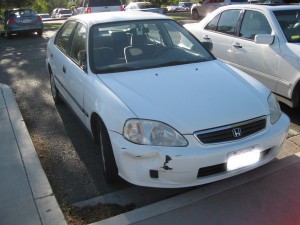
- The official SCVTalk Hoopty, a 1999 Honda Civic worth less than my road bike that can do 60 mph on a good day
- Garmin Edge 305 Bicycle GPS computer
- Citizen EcoDrive Chronograph wristwatch
- WiFido, my copilot and test subject
- Myself, the biggest and most important tool

The Route:
To study whether traffic is as bad as everyone seems to think it is, I chose a medium length route at one of the busiest times of the day. I drove from my home in Newhall to Central Park using a deliberately circuitous and traffic-light filled route, right through Valencia. I touched just about every major intersection in the south and central valley, rather than take Railroad Avenue which has few lights and is relatively high speed.
I left home at around 5:17pm (rush hour, such that it is) on Wednesday 5/19/10 with WiFido eager to get to Central Bark.
I stopped at Trader Joe’s on the way back but forgot to tell the GPS computer to stop recording. So that test was thrown out. But the results were similar, if a bit faster because I took Railroad home.
The Results:
First, the qualitative results. I experienced very little traffic congestion going north from Newhall. Orchard Village road was clear, and I probably hit my high speed mark there at 47 mph. The right turn on McBean backed up a bit, but it was no more than 45 seconds before I was at the light, waiting to turn right. I made it from Orchard Village & McBean to Valencia Blvd only stopping twice at Arroyo Park and Del Monte. I didn’t have to wait long at the right hand turn from McBean onto Valencia Blvd.
As I approached Bouquet and Soledad, the left turn light went green when I was at about K-Mart. To my surprise, it stayed green until I made it through the intersection. Dozens of cars made it through with me; there are an astounding three turn lanes at that intersection.
Once I got onto Bouquet, some minor congestion occurred. I was stuck in the intersection of Bouquet and Soledad for about 5-8 seconds. Traffic was somewhat congested from Lowes to at least Seco. The GPS record shows that that portion of the trip took 1 minute and 56 seconds, though that doesn’t include stop time. I snapped a pic:
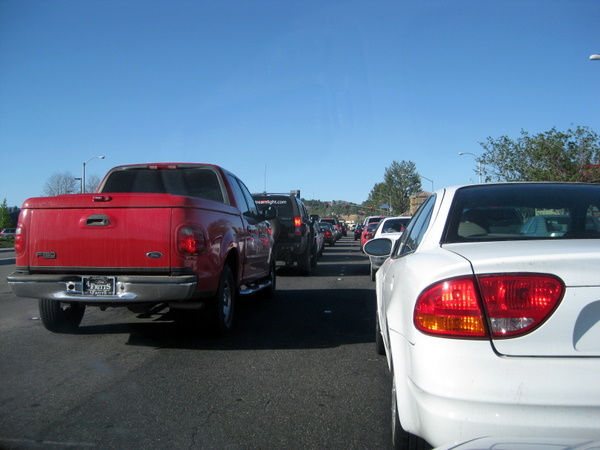
ZOMG Traffic! The 4th worst problem in all of Santa Clarita, visualized. You can't see it, but I was pumping my fist and honking like any good SCV motorist.
Once past Seco, it was smooth sailing to Central Park. My copilot WiFido had survived the long (or was it?) ride without wetting himself or the Honda:
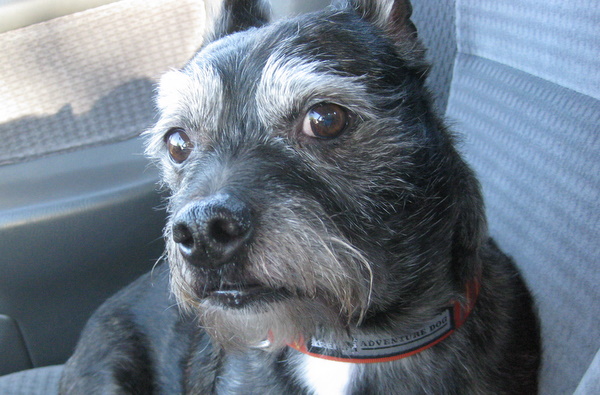
Hurry! Gotta go!
Now, the quantitative data. The Garmin Edge 305 GPS Bicycle Computer works by locking onto the signal of three or four global positioning satellites located in geosynchronous orbit 23,200 miles above the Earth. The device then compares its position to the fixed points in the sky, and through some complicated mathematics way beyond my capacity to understand, outputs miles per hour, average speed, time moving, time stopped, and a few other data points not related to this test (I really don’t think I burned 300+ calories driving to the dog park).
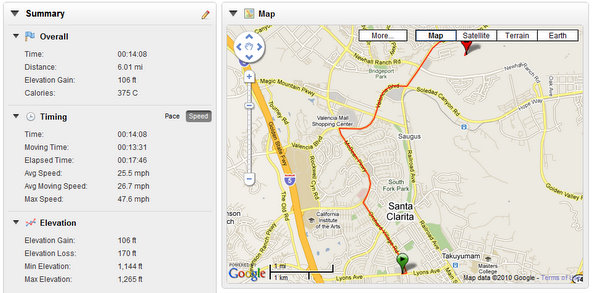
So here are the results:
And just to cross check, here’s the Citizen Watch:
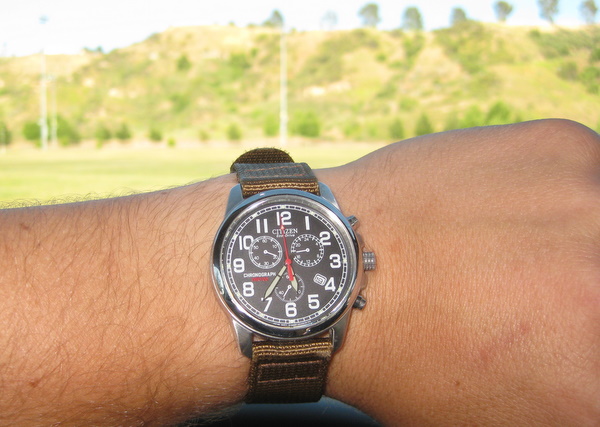
The tiny dial in the top left is stopped just short of 20 minutes
As you can see, total trip time was less than 20 minutes according to both devices. The Garmin recorded for a total of 17:46 from the time I pushed the start button at Apple & Lyons to the time I pushed the stop button at Central Park. I spent 13:31 minutes of that time moving, meaning I spent about 4 minutes and 15 seconds stopped, likely in traffic lights or moving so slowly (generally less than 1 mph, it’s very sensitive) the computer didn’t pick it up.
The average speed for the 6.01 mile trip was 26.7 mph (moving). Max speed was 47 as noted above. Average pace is about 2 minutes 21 seconds per mile. You can review the results here, or watch a replay of the recording (with a really nice speed vs distance chart that shows my stops) here.
Discussion:
If I were to rate my trip on a scale of 1-10, with 10 being an absolute pleasurable and quick drive, I would rate it at an 8. I traveled virtually un-impeded for much of the journey. The only difficult part was Bouquet Canyon road near Lowes.
Was I frustrated on Bouquet? A little bit. I think I was spoiled by the rest of the trip being so fast that when I got to Bouquet it was kind of a rude shock to find bumper-to-bumper traffic. But that underscores one crucial point in this debate: we cover a lot of ground on our roads here in the SCV. 6 miles in just under 18 minutes is a really good time. To put it another way, 6 miles is the distance from Wilshire Blvd & Ocean Park Drive in Santa Monica to the Beverly Hilton on Wilshire Blvd in Beverly Hills. Try doing that in 18 minutes during rush hour!
At the same time, I can see how the frustration can add up. You’re driving along. Most of your route is very fast and easy. Then you come upon moderate congestion. You get frustrated, but get through it. Then on your way back, you hit the same congestion going the other direction. Suddenly those wasted 4 minutes double to 8 minutes, and pretty soon, you’ve blown a half hour sitting in traffic or moving very slowly through it as you go about completing your tasks.
That’s where my attempt at sympathy ends. Mostly, I think we’re a bunch of selfish, spoiled brats who think we each deserve our own lane of the road. We don’t ever think of ourselves as traffic; traffic is what all the other people in their cars represent to us. We don’t mind speeding if it gets us to where we’re going faster, but heaven help us if someone else speeds through our street. And, like the guy quoted above, we consider it a personal affront to wait at stop lights, even if it’s just for 90 seconds.
Which then licenses us to hurl abuse at City Hall and transportation engineers.
The Take-away
Look. Here’s the bottom line, or the take-away if you will (everyone is using that phrase these days it seems). Transportation costs us in both time and money. You drive a car partly because you value your time more than your money, at least as it compares to other options like transit. But when you sit in congestion, even for just a few minutes, it makes the investment you made in your car seem less valuable because now, your time is being wasted.
Which makes you angry and prone to over-react.
But if you look at the big picture and consider how fast you drive and how much ground you cover during most segments of your trip, it’s really not so bad. It’s still the fastest way to get around Santa Clarita, even with areas that have higher than normal congestion. And that’s why I don’t think traffic congestion is that big of a problem in Santa Clarita.
Comments
11 · as published