
The media push for the AEA charter continues with a KHTS Radio spot ahead of the Albert Einstein Academy's big hearing tonight before the Saugus Union School District Board.
Earlier this week, a mailer hit some SCV mailboxes urging parents to support "school choice" by showing up to the meeting tonight and pressing their support for the school, which has been denied charter status by districts in Ventura County, Santa Clarita, and the LA County Office of Education:
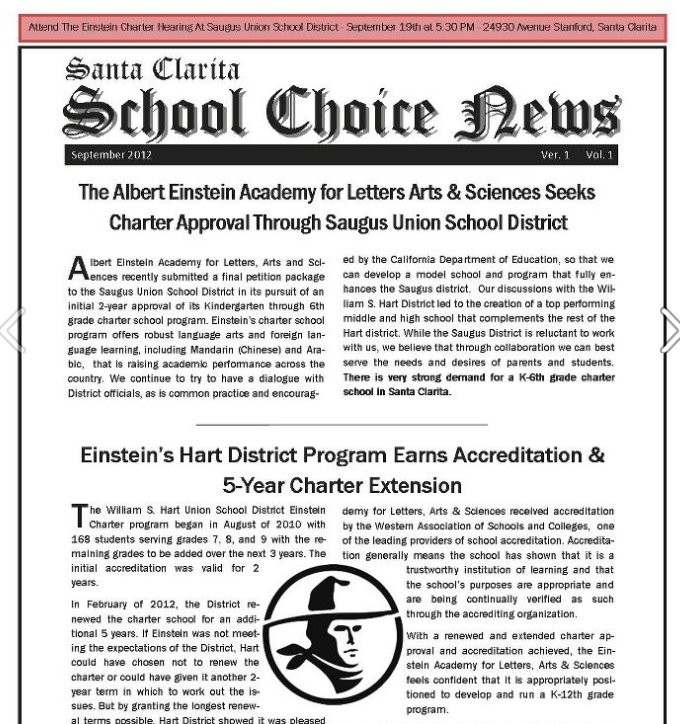
A note from an Einstein skeptic regarding AEA's mailer:
Meanwhile, comments continue to come in about Notes from Newhall's last post on the topic,where we looked at the ethnic makeup of AEA's middle schools compared to traditional public districts in the SCV using Dr. Winger's comments before the LA County Office of Education board last year. Here's one charter supporter's comment:
Unfortunately for AEA boosters, that's not what the law says. Excerpted from last year's LACEO report on AEA's application appeal:
The disparities between the Albert Einstein Junior High & High School compared to other Hart Districts are are indeed shocking.
Again from the LACOE report:
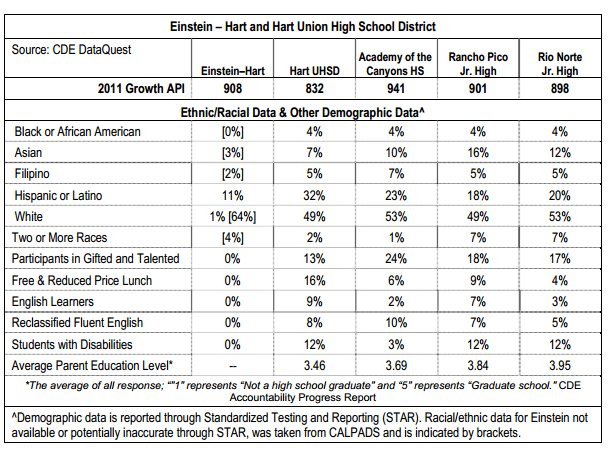
I don't know where the reader is getting a 4 and 5% figure for free and reduced lunches at AEA because this report, and the comments submitted by Dr. Winger, show that 0% of AEA students receive free or reduced lunches. As Winger notes in his commentary, free and reduced lunches is a measure of poverty in school districts. At the NSD, 30% of students are in the National School Lunch Program (NSLP). At Saugus, it's 17%.
As for the politics surrounding free & reduced lunch- I'm not sure what the reader is referring to. Schools are reimbursed by the federal and state government for how many students are in the program, so I imagine you could argue they have an interest in over-reporting NSLP recipients, but numbers are reported by a third party agency named the SCV School Lunch Program. Besides, is this really the debate AEA wants to have? The NSLP feeds kids who otherwise might not get a decent meal during a school day, and as such, it represents a decent measure of poverty in the District.
But Einstein, by its own numbers, won't educate or feed too many poor students.
Another reader thinks the demographic numbers don't matter:
We tried the whole separate but equal school system in the first half of the 20th century, remember?
The same reader on the $2,500 AEA donation request we covered in the last post:
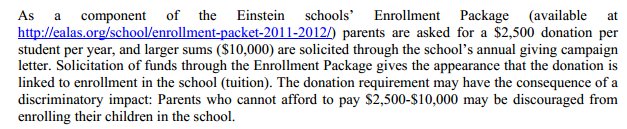
It's not fair to judge AEA's petition this year on an enrollment package from last year (the URL mentioned in the report is dead), but still, that's a bad sign, isn't it? Any lower income parent seeing that "suggestion" will likely decline to send their student to that school.
What do they need that $2,500 for anyway? Dr. Winger quotes the principle of AEA's middle school as saying this:
Dr. Winger says that quote is from the February 2011 donation "appeal letter to parents." Is Winger's citation accurate?
Two last comments from readers regarding that whole "school choice" concept and the amazing performance of McGrath Elementary, one of the SCV's more disadvantaged yet high performing schools:
SCV Parents do have school choice. There are multiple private religious and private secular schools throughout the valley. There are dozens over the hill in the SFV and the marketplace does not forbid the creation of private schools anywhere in the SCV. Finally, the Signal covered this weekend the local home schooling movement, which enjoys uncontroversial and apparently mutually beneficial support from the traditional Districts.
In short, our traditional public schools are above average to excellent, private alternatives to public schools seem to be flourishing, and parents can educate their children at home with the support of school districts if they like. Why should the public support charters again?
Here's the Agenda for SUSD's special meeting tonight.
Albert Einstein reaction, ctd.
Earlier this week, a mailer hit some SCV mailboxes urging parents to support "school choice" by showing up to the meeting tonight and pressing their support for the school, which has been denied charter status by districts in Ventura County, Santa Clarita, and the LA County Office of Education:

A note from an Einstein skeptic regarding AEA's mailer:
The pamphlet the Einstein people have produced is pretty typical of their dishonest way of doing their business. It might be worth asking if they had permission to use the Hart District logo in their pamphlet, implying an endorsement of their program. And why no mention of their significant conditions for renewal? They make it sound like Hart loves them to make their case before Saugus. Not quite so.Indeed, in their radio spot, they mention their recent renewal and accreditation as if it validated their strategy for their elementary school plans.
Meanwhile, comments continue to come in about Notes from Newhall's last post on the topic,where we looked at the ethnic makeup of AEA's middle schools compared to traditional public districts in the SCV using Dr. Winger's comments before the LA County Office of Education board last year. Here's one charter supporter's comment:
So you are arguing that we should compare apples to apples, schools to schools rather than AEA to an entire school district, which covers a much larger geographic territory than a single school does.I appreciate your sharing that information, though what you've presented is skewed, at best. I think a more appropriate comparison would be a comparison of demographics at AEA, a west side school, with other west side schools. The Hispanic decent demographics for our west side high schools West Ranch and Valencia are (according to GreatSchools) 19 and 22% respectively, with Rio Norte, the closest middle school coming in at 16%. Higher than AEA's 11%, but not nearly the shocking disparity the district numbers produce. The free and reduced lunch numbers are 4 and 5%, much lower than the district figures, and to be honest I imagine that AEA's numbers are not accurate. There is some cost and politics involved in free and reduced meal service (which I'm not familiar with enough to provide details) that results in many charters opting to offer their own in-house 'scholarship' free and reduced meal service.
Unfortunately for AEA boosters, that's not what the law says. Excerpted from last year's LACEO report on AEA's application appeal:
Recognizing the limitations on admissions to charter schools imposed by EC § 47605(d), the means by which the school(s) will achieve a racial and ethnic balance among its pupils that is reflective of the general population residing within the territorial jurisdiction of the school district…, as required by EC §47605(b)(5)(G), shall be presumed to have been met, absent specific information to the contrary.Emphasis mine. That's a fancy way of saying that a charter school must reflect the student body of the district as a whole, not a specific high school or junior high in West Ranch.
The disparities between the Albert Einstein Junior High & High School compared to other Hart Districts are are indeed shocking.
Again from the LACOE report:

I don't know where the reader is getting a 4 and 5% figure for free and reduced lunches at AEA because this report, and the comments submitted by Dr. Winger, show that 0% of AEA students receive free or reduced lunches. As Winger notes in his commentary, free and reduced lunches is a measure of poverty in school districts. At the NSD, 30% of students are in the National School Lunch Program (NSLP). At Saugus, it's 17%.
As for the politics surrounding free & reduced lunch- I'm not sure what the reader is referring to. Schools are reimbursed by the federal and state government for how many students are in the program, so I imagine you could argue they have an interest in over-reporting NSLP recipients, but numbers are reported by a third party agency named the SCV School Lunch Program. Besides, is this really the debate AEA wants to have? The NSLP feeds kids who otherwise might not get a decent meal during a school day, and as such, it represents a decent measure of poverty in the District.
But Einstein, by its own numbers, won't educate or feed too many poor students.
Another reader thinks the demographic numbers don't matter:
I see groups quote demographic percentages often to assert some kind of discrimination is taking place in schools, careers, clubs, military, sports, etc. While I’m sure discrimination assuredly raises its ugly head often, these percentages alone don’t prove anything. Take nursing for example – I recently looked at a study from 2003 that stated that over 75 percent of nurses in the US are female. Does that mean that men are being excluded or discriminated against because more women are in the nursing demographic than in the general population? Or could it be true that generally more women seek out these careers than men? How about sanitation workers? I would bet the numbers are skewed in the opposite direction. My point is that demographic numbers mean nothing on their own, and in the case of AEA where they have to accept the students as they apply exclusion can’t take place.The problem with this logic is that there is no legal or ethical reason to educate everyone as nurses or train them as sanitation workers. There is, however, legal and ethical reasons to ensure every child gets an adequate and equal education, for free, in a school that is representative of their community.
We tried the whole separate but equal school system in the first half of the 20th century, remember?
The same reader on the $2,500 AEA donation request we covered in the last post:
I've been told that AEA's suggested donation is quite high. I'm not sure how successful their giving campaign is. It would be interesting to see. SCVi does ask for family giving donations, but it's a pretty laid back request, and a more reasonable figure ($365 per family).
And another reader on that same topic:
You mentioned a $2500 donation per student per year. While our daughter attended AEA we did make some donations to the school when we could, but we never paid close to that amount. The school did solicit donations while our daughter attended middle school; however, there never was any harassment nor any disparagement to our daughter or us when we didn’t pay. Donation solicitation is not exclusive to charter schools. We were constantly hounded for money throughout our daughter’s traditional elementary school years.
Do local traditional public schools really ask parents for donations even close to $2,500? The LACOE report mentioned that number specifically and said the school's Enrollment Package even asked for larger sums up to $10,000:

What do they need that $2,500 for anyway? Dr. Winger quotes the principle of AEA's middle school as saying this:
"It allows us to provide a private school education in a tuition-free, public school setting."Wow.
Dr. Winger says that quote is from the February 2011 donation "appeal letter to parents." Is Winger's citation accurate?
Two last comments from readers regarding that whole "school choice" concept and the amazing performance of McGrath Elementary, one of the SCV's more disadvantaged yet high performing schools:
I don't think anyone could argue that McGrath isn't doing amazing things, but part of what they're doing is offering an innovative program that is uniquely tailored to the needs of their student body, as opposed to the one size fits all approach that is prevalent in much of the traditional school system. If anything, McGrath is an example of the amazing things innovative educational models and passionate educators can accomplish. Yes, absolutely that is possible within district schools, but as of yet our districts have been reluctant to step out of that traditional box.and
I mentioned that a benefit to charter schools is that it motivates current schools to innovate and improve to compete with the other options. You brought up McGrath Elementary and West Creek Academy as traditional school success stories. Great! I don’t think all the traditional schools are poor, and that parents don’t love their children any less if they don’t send their children to charter schools. Remember, we are sending our daughter to “traditional” Saugus for high school and we are very pleased with the level of education she is receiving there. I’m basically saying that options are good, and the competition should drive up the quality of both sides. When I go shopping I like choices – sometimes I’m in the mood for Cabernet, sometimes I want Chardonnay, sometimes a beer. What would life be like if all that was ever available was Merlot?I'd prefer if life was all Shiraz, but I get your point. And yet, I'm not convinced.
SCV Parents do have school choice. There are multiple private religious and private secular schools throughout the valley. There are dozens over the hill in the SFV and the marketplace does not forbid the creation of private schools anywhere in the SCV. Finally, the Signal covered this weekend the local home schooling movement, which enjoys uncontroversial and apparently mutually beneficial support from the traditional Districts.
In short, our traditional public schools are above average to excellent, private alternatives to public schools seem to be flourishing, and parents can educate their children at home with the support of school districts if they like. Why should the public support charters again?
Here's the Agenda for SUSD's special meeting tonight.