
John Zaring, a writer under the Democratic Voices banner, was let go today by Publisher Randy Morton, Zaring says on Facebook:
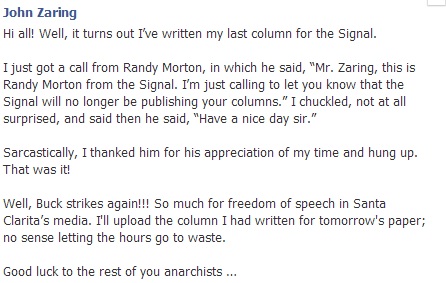
This follows the Signal's suppression of at least one or two Lee Rogers endorsement columns per the Signal's policy of not publishing endorsement pieces within a week of election day. Of course that policy didn't apply to Buck McKeon or his various water carriers in the SCV, as we documented about 10 days ago.
Zaring had one column left to publish, and since it's never going to see the light of day in the Signal, he sent it to me. It's published below, in full:
really bad stomach flu. I’m sure my Republican readers have experienced similar feelings this past
week, especially after watching GOP surrogates hit the various cable news outlets in the final days all
predicting Governor Mitt Romney would knock President Barack Obama out of the White House and
return control of the Senate to Republicans.
They said America’s recovery from the Great Recession was too stilted for an impatient populace,
and I must admit, Romney had grown quite adept at spinning a bleak future under another Obama
term. Then Benghazi happened, throwing real red meat at the feet of Beck, Limbaugh and Hannity.
GOP kingmaker Karl Rove went on FOX News to join the chorus of Republicans predicting an electoral
landslide for Romney.
Well, Rove and company got the landslide part right – the final tally was 332 to 206 – but it was Obama
who emerged victorious. Not even a billion dollars worth of negative Super PAC ads from the Koch
Brothers and casino maven Shelden Adelson could prevent the American people from moving forward,
not backward. When the dust cleared, Democrats not only kept the White House, but gained seats in
both the House and Senate, including big Senate wins in Massachusetts and Virginia, as well as Indiana
and Missouri, two red states where Republican victories are usually a foregone conclusion. Tea party
incumbents were sent packing in key Congressional races, most notably controversial flame-thrower
Allen West in Florida. Even Michelle Bachman barely eked out a victory.
GOP leaders should be asking themselves how this happened, and what lessons can be learned …
I believe that Romney’s positioning in the GOP primaries hurt him last Tuesday. After coming down
squarely against Obama-care, illegal immigration, abortion rights, gay rights and government bailouts to
fend off challengers Rick Perry, Rick Santorum and others more appreciated by the party’s evangelical
and tea party base, it was harder for him to return to the center. When he tried, it reinforced concerns
among moderates from both parties that Candidate Romney was a spineless opportunist who would say
just about anything to anyone to become President Romney. And finally, there were the foot-in-mouth
tea party-backed candidates Todd Akin and Richard Mourdock, whose comments about “legitimate
rape” and whether a pregnancy resulting from rape was “something God intended” drew unwanted
attention to just how far right the party had drifted.
With both unemployment and the economy trending in the right direction, President Obama managed
wins in Ohio, Virginia, Florida, Wisconsin, Colorado, New Mexico and Nevada, and defeated Romney’s
Hail Mary to put New Hampshire and Pennsylvania back into play. He only lost North Carolina and
Indiana, two traditionally Republican states, among the swing states where everyone knew this election
would be fought and decided.
Even with a convincing Electoral victory, Obama must be very careful to avoid prideful hubris, and not
over-read the election’s results. The truth is he won the popular vote by just about three million votes,
a smaller margin than in 2008, and after a year-long, brutal roller-coaster race faces a country even
more fractured than when he first moved into 1600 Pennsylvania Avenue.
Second terms are often treacherous, something George W. Bush, Bill Clinton and even Ronald Reagan
learned. Obama must find a way to bridge a stubborn partisan divide because this nation’s economic
recovery is far too tenuous for four more years of partisan animosity. America needs a saner set of
immigration laws, simplified tax code, reformed entitlement programs and reductions in spending in
domestic AND defense programs.
With the Bush tax cuts, along with several other temporary measures passed under Obama, expiring at
year’s end, and automatic spending cuts – known as sequestration – set to take effect under terms of
a stop-gap budget deal reached by Congress when the so-called Super Committee failed to handle the
Debt Ceiling crisis back in the summer of 2011, Obama and leaders from both parties must pull together
to avoid sending our nation right back into recession.
Will they? Can they? They must.
No American, including those who supported Romney, can afford to see Obama fail. The 51-year old
President has an opportunity to cement a legacy in health care policy but now must use the modest
leverage of victory to lead Congress through a series of looming confrontations over taxes, the budget,
deficit and social safety net programs relied upon by tens of millions of Americans (those people
Romney ineptly referred to as “takers” in his infamous 49% comment to big dollar donors).
Folks, ultimately we the people bear responsibility for the gridlock gripping Washington. Americans
voted for divided government so we too must put away our ideological anger and encourage our
legislators to put country before party. Beginning today, let’s all advocate for the common good,
because if compromise doesn’t happen, we’ll be up the proverbial creek in a leaky boat without a
paddle.
-----------------
Signal releases liberal columnist John Zaring

This follows the Signal's suppression of at least one or two Lee Rogers endorsement columns per the Signal's policy of not publishing endorsement pieces within a week of election day. Of course that policy didn't apply to Buck McKeon or his various water carriers in the SCV, as we documented about 10 days ago.
Zaring had one column left to publish, and since it's never going to see the light of day in the Signal, he sent it to me. It's published below, in full:
Obama Won! Now what?!
John Zaring
I vividly remember what it felt like when George W. Bush won reelection in 2004. It felt like, well,really bad stomach flu. I’m sure my Republican readers have experienced similar feelings this past
week, especially after watching GOP surrogates hit the various cable news outlets in the final days all
predicting Governor Mitt Romney would knock President Barack Obama out of the White House and
return control of the Senate to Republicans.
They said America’s recovery from the Great Recession was too stilted for an impatient populace,
and I must admit, Romney had grown quite adept at spinning a bleak future under another Obama
term. Then Benghazi happened, throwing real red meat at the feet of Beck, Limbaugh and Hannity.
GOP kingmaker Karl Rove went on FOX News to join the chorus of Republicans predicting an electoral
landslide for Romney.
Well, Rove and company got the landslide part right – the final tally was 332 to 206 – but it was Obama
who emerged victorious. Not even a billion dollars worth of negative Super PAC ads from the Koch
Brothers and casino maven Shelden Adelson could prevent the American people from moving forward,
not backward. When the dust cleared, Democrats not only kept the White House, but gained seats in
both the House and Senate, including big Senate wins in Massachusetts and Virginia, as well as Indiana
and Missouri, two red states where Republican victories are usually a foregone conclusion. Tea party
incumbents were sent packing in key Congressional races, most notably controversial flame-thrower
Allen West in Florida. Even Michelle Bachman barely eked out a victory.
GOP leaders should be asking themselves how this happened, and what lessons can be learned …
I believe that Romney’s positioning in the GOP primaries hurt him last Tuesday. After coming down
squarely against Obama-care, illegal immigration, abortion rights, gay rights and government bailouts to
fend off challengers Rick Perry, Rick Santorum and others more appreciated by the party’s evangelical
and tea party base, it was harder for him to return to the center. When he tried, it reinforced concerns
among moderates from both parties that Candidate Romney was a spineless opportunist who would say
just about anything to anyone to become President Romney. And finally, there were the foot-in-mouth
tea party-backed candidates Todd Akin and Richard Mourdock, whose comments about “legitimate
rape” and whether a pregnancy resulting from rape was “something God intended” drew unwanted
attention to just how far right the party had drifted.
With both unemployment and the economy trending in the right direction, President Obama managed
wins in Ohio, Virginia, Florida, Wisconsin, Colorado, New Mexico and Nevada, and defeated Romney’s
Hail Mary to put New Hampshire and Pennsylvania back into play. He only lost North Carolina and
Indiana, two traditionally Republican states, among the swing states where everyone knew this election
would be fought and decided.
Even with a convincing Electoral victory, Obama must be very careful to avoid prideful hubris, and not
over-read the election’s results. The truth is he won the popular vote by just about three million votes,
a smaller margin than in 2008, and after a year-long, brutal roller-coaster race faces a country even
more fractured than when he first moved into 1600 Pennsylvania Avenue.
Second terms are often treacherous, something George W. Bush, Bill Clinton and even Ronald Reagan
learned. Obama must find a way to bridge a stubborn partisan divide because this nation’s economic
recovery is far too tenuous for four more years of partisan animosity. America needs a saner set of
immigration laws, simplified tax code, reformed entitlement programs and reductions in spending in
domestic AND defense programs.
With the Bush tax cuts, along with several other temporary measures passed under Obama, expiring at
year’s end, and automatic spending cuts – known as sequestration – set to take effect under terms of
a stop-gap budget deal reached by Congress when the so-called Super Committee failed to handle the
Debt Ceiling crisis back in the summer of 2011, Obama and leaders from both parties must pull together
to avoid sending our nation right back into recession.
Will they? Can they? They must.
No American, including those who supported Romney, can afford to see Obama fail. The 51-year old
President has an opportunity to cement a legacy in health care policy but now must use the modest
leverage of victory to lead Congress through a series of looming confrontations over taxes, the budget,
deficit and social safety net programs relied upon by tens of millions of Americans (those people
Romney ineptly referred to as “takers” in his infamous 49% comment to big dollar donors).
Folks, ultimately we the people bear responsibility for the gridlock gripping Washington. Americans
voted for divided government so we too must put away our ideological anger and encourage our
legislators to put country before party. Beginning today, let’s all advocate for the common good,
because if compromise doesn’t happen, we’ll be up the proverbial creek in a leaky boat without a
paddle.
-----------------