
SCV Talk · Archive
Nine years of the Valley’s town square · 2006–2015
SCV Talk
April 20, 2010· scvtalk.com · WordPress (SCVTalk 3.0) · Wayback capture

Awesometime?

Image not recoveredIMG_1795.JPG

New construction in the West Hills village of Valencia.

The sometimes cringe-inducing “Awesometown” adverts are in full effect, with the morning drive traffic reports sponsored by the now pervasive push by Newhall Land to snatch up stucco boxes before the Federal and State tax credit money is gone.  NL is on an ad-blitz because the window for a “double dip” tax credit (their phrase) will close by the end of April (that’s just nine days from now).

So – is it time to buy a new home in Radsville?

I’ve done some analysis on arguably the two most important tell tale buy signs and can say dispassionately that for those with a long term view, it is indeed a good time to buy – specifically in SCV zip codes 91350, 91351, and 91354.  Turns out Newhall Land’s three major residential projects are in two of those zip codes, 91350 (RiverVillage) and 91354 (West Creek, West Hills).

Reasons you should buy

1) Incomes are in line with home prices.

Families in the Sweetboro zips can actually afford to buy their homes.  This wasn’t true during the bubble years.  Additional factors can drive home prices further downward, but those are external and largely unknown (more on this in a bit).

I tabulated information published by DataQuick (the same source that is used by the weekly LA times report) on median home prices for SCV zip codes as of March 2010.  I also added household income statistics as of the last commonly available reporting period, 2008.
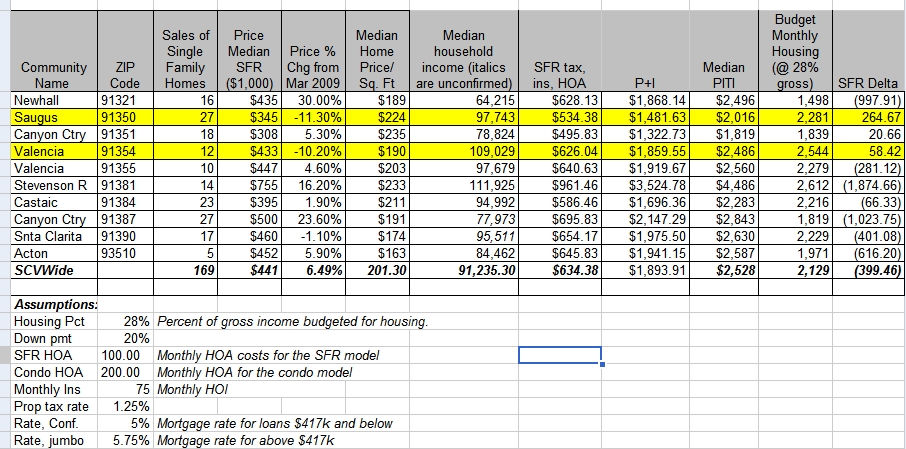
Three SCV zips show values in line with incomes. Two are in Awesometown.

There is an obvious sensitivity to any number of assumptions on this spreadsheet, but I was generally conservative.  The math goes like this: how much home can the median income family afford?  And how much would it cost for the median home in that zip? Important caveat: this analysis only shows single family residences (SFR), as there is no easy way to separate median incomes by housing type.  By isolating SFR values and comparing with all household incomes the analysis is even more conservative: the mix of condo-dwelling households is material, both on the sales and income datasets.

The income / SFR price balance is limited to three zip codes only.  A number of SCV areas remain out of whack, notably Stevenson Ranch, which was largely built out during the go-go days of home finance.  Because of the SFR bias in the analysis, areas with a lower median household income should be re-evaluated with a methodology that takes condos into account.

2) It’s cheaper to buy than rent.

A scan of Kickassplace rentals on rent.com, Westside Rentals, and Craigslist yielded newer 3 bedroom, 2 bathroom SFRs between $2,000 and $2,500.  A fourth bedroom adds about 10%. Comparing with the median values — on a pure cash basis — buying a property is slightly better than parity compared with renting.  The mortgage interest tax deduction seals it, and if you’re not subject to AMT, the property tax deduction also saves a few dollars.

3) Timely enticements

Without any additional financial incentives, the numbers line up quite favorably.  NL’s “double dip” line really is gravy, and makes an even more compelling case to listen to the hype:

  • By any measure, interest rates are quite low.  Since affordability is inextricably tied to rates, this is already baked in to prices.  However, with an FHA loan, the locked-in low rate provides assumability in the event rates climb going forward.
  • Feds are giving out tax credits of up to $8,000 for new homebuyers, and $6,500 for move-up buyers.
  • Arnold is giving out $10,000 in tax credits ($3,333 per year for 3 years) for new home buyers
  • The builders are throwing in additional incentives, such as landscaping and interior add-ons

Image not recoveredIMG_1789.JPG

Newhall Land lots prepped for construction, which has notably ramped up in recent weeks ahead of the tax credit deadlines.

Reasons you should wait

1) Distressed properties remain

This is the biggest unknown facing the housing market.  What’s also unknown is how distressed properties will be triaged by lenders cum owners.  There are two schools of thought: one, the distressed properties will lead to further steep price pressure on the market or two, some combination of Uncle Sam and the banks will do everything they can to prevent the distressed properties from further major impact.  Neither has come to pass.

2) Interest rates will go up, causing prices to go down

Perhaps.  Rates have thus far surprised most everyone, including me.  The best protection against rate increases is an FHA loan.

3) You have a short (1-5 year) time horizon

Residential real estate isn’t meant to be flipped. ’nuff said.

I’m not a real estate expert, nor am I connected to the industry.  I’m someone who sat on the sidelines for a few years with my family, bouncing between rentals and finally took the plunge just over a year ago.

Is this the best time ever to buy a home in Awesometown?  No.  But it’s a hell of a lot more favorable than just about any period in the last five years.  Especially if you have a longer-term horizon… and can’t stand your rental in Crapsburg.

Awesometime?

Comments (20)

  1. drive66April 20, 2010 at 1:32 pm
    Wow, saying that “it’s a hell of a lot more favorable than just about any period in the last five years” is incredible. Of course it’s better, we just went through the biggest RE bubble in history. It sounds like you are trying to justify buying in 2009. It took 10 years for the market to recover in the last down turn and that RE bubble had nothing on this one. http://www.laalmanac.com/economy/ec37.htm You are looking at 2017 at least for prices to recover which will continue to cause downward pressure. A RE collapse is like a train wreck in slow motion. You need to research RE history, it’s cyclical. Also you are using median prices which isn’t a good indicator due to the mix of distressed REO properties and higher end homes coming on the market which will distort the median. Lower end homes might be inline with incomes but newer, nicer homes have a long way to go. All the incentives in the world aren’t going to stop RE from falling until you reach the mean.
  2. drive66April 20, 2010 at 3:09 pm
    Nickel/Dime wrote: The “mix of high end homes” you cite is bogus. High end homes aren’t selling well at all. If anything, the figures are skewed the other direction. You are wrong. As higher end homes start to sell because sellers lower their expectations and prices it raises median prices. But prices are still dropping and will do so for quite some time. Is it a good time to buy you ask. If you are willing to be underwater for years, I guess it is. All the tax credits aren’t going to matter if your 100k in the red. I do not think your math works at all. I also do not believe a nice 2200sf is in line with median incomes in general. Maybe in the zip codes you listed but RE isn’t just local. If a friend asks me if it’s a good time to buy, I’d say if you can wait, wait. prices will continue to drop. If you can handle being underwater for years to come and plan on staying in the home for 10+ years, go for it. BTW, my situation is almost identical to yours. The only difference is I am a realist.
  3. drive66April 20, 2010 at 5:31 pm
    I’m not here to come up with equations, just to offer a different point of view. My opinion. I think the things I’ve said are quite reasonable. Home prices will continue to fall. If you can wait, you should, homes will be cheaper. I’m not saying wait till 2017, all I said is it took 10 years for RE to recover in the last down turn. Just because you can afford it doesn’t make it a good deal. Anyhow, I hope you’re right and it is a good time to buy, it would be awesome to stop losing equity in my home and yours.
  4. drive66April 20, 2010 at 9:31 pm
    Give me a break. Option ARMs came out at the end of the bubble. What drove prices up was easy credit, lax lending rules, deregulation. NIJA loans. As prices went up, prices went through the roof, feeding on themselves. Just as prices going down have the same effect. The more they go down, the more they go down. It’s the herd mentality. You sound like a realtor.
  5. drive66April 21, 2010 at 9:16 am
    Look, the bubble started in 2000, maybe 1999. option ARMs didn’t become heavily used until 05-06. As I said, easy credit, no money down, NIJA loans started it all with a “RE never goes down” philosophy. It’s a classic bubble. The point is you say there are signs that it is a good time to buy and I disagree. If you can afford the payment and don’t mind the value of you house plummeting (and you neighborhood filled with foreclosures) go ahead. Just do it with your eyes open.If you can wait, better deals are to be had.
  6. ReaderMamaApril 20, 2010 at 2:16 pm
    We bought in 2009 too, after renting for 9 long years. Prices finally came down far enough so that renting was no longer cheaper — or at least not cheap enough to justify the inconvenience of renting. When you have kids and pets, renting is no fun. And the real estate bubble didn’t make renting any easier. We lived in three different places over the course of nine years. One owner went into foreclosure on us. The last one ended up divorced and will probably be in foreclosure in the next year or so.
  7. WalkerApril 20, 2010 at 3:42 pm
    I’ll agree w/you on two points. Reason not to buy 1 and reason not to buy 2 (but mostly reason not to buy 1). It’s going to be BAD. We haven’t even begun to see the effects of the ghost inventory. And what is to happen when all these silly rebates expire? It’s going to be BAD. Really bad. The lower prices get, the more people will walk. The longer mortgage companies sit on these ghost properties, the bigger the implosion will be.
  8. WalkerApril 20, 2010 at 6:33 pm
    What would I consider the ‘average’ home for Awesometown alone? Assuming we’re talking SFR, I would say something in the 500K range. Average for the SCV, though, more in the $350-$400K range, which would be the low end of SFR for Awesometown. We just sold our house. Our neighbors are walking away like crazy and we’re afraid for what will become of our neighborhood. We were fortunate enough to buy before things were crazy and were able to get out. Our neighbors are sitting on homes they haven’t paid for in months and haven’t so much as heard a peep from the mortgage company. We was talking to a neighbor last night (who is thinking of selling as well, an older couple) and he knows of 3 owners who are in the process of walking. I can add my immediate neighbor and the person on the other side of them. Plus….and maybe this is nothing….but there have been quite a few homes that go up for sale and within a day or two the for sale sign is gone. I’m guessing it’s people who realize there is no benefit in CA to selling as a short sale, that they might as well sit around in their home rent/mortgage free until the bank gets around to taking it. In CA there really is no difference between the two, except that the one lets you live rent/mortgage free for months/years.
  9. ReaderMamaApril 20, 2010 at 7:04 pm
    Walker, I’m curious to know where you live and where you are going. Are you moving out of SCV or are you going to rent?
  10. WalkerApril 20, 2010 at 7:35 pm
    The previous house was in N.Valencia and we’re staying in the SCV, hoping to buy sooner than later, but waiting for the silly rebates to end, 2005/6 ARMs to mature and ghost inventory to come on the market. We’re renting from friends who can’t sell and needed to move.
  11. WalkerApril 20, 2010 at 8:25 pm
    Oh I totally agree that the government will (and has) draw out the inevitable drop as long as possible. The mortgage companies will hold onto their ghost inventory as long as possible. I expect to see a steady stream of foreclosures for the next 3-4 years (as todays ghost inventory is finally made available, and the ARM inventory lives out it’s 1-2 years in foreclosure and is finally made available) and as soon as the government stops handing out money to homebuyers the pool of buyers will dwindle. Like you said above, rates will raise and payments will be similar w/what they are today, but prices will be significantly lower.
  12. ReaderMamaApril 20, 2010 at 4:39 pm
    It will be interesting to see how it all pans out. Real estate may not be just local, but local is where we live and where we are buying. I’ve been hearing tales of “ghost inventory” for a couple of years now. So far there’s little sign of it here in Awesometown. We bought our townhome for half what it would have sold for at the peak. We looked at quite a few foreclosure properties, but they were usually in very bad shape and (we thought) overpriced. Nevertheless, someone bought them.
  13. WalkerApril 20, 2010 at 8:54 pm
    The reason you don’t see it is because the mortgage companies are allowing the current occupants to stay, so there really isn’t anything to ‘see’, unless the occupant leaves on their own (which has happened to a few homes in our old hood, and we had been keeping up the lawn/etc). The foreclosed homes don’t really exist as defaulted homes (yet) because the mortgage company is not pursuing foreclosure in any sort of timely manner. Then there is the issue of the modifications that will ‘mature’. Many of the modifications (for those who could get them) are very much a short term solution. Verly minimal (or no) interest for a few years and then back to previous terms after a 3-5 year period. I’m not expert, but what seems to me to have been a more realistic approach would have been a silent second modification scenario. Who knows how that might have worked, but it seems far more helpful than throwing more ARMs at people.
  14. ReaderMamaApril 21, 2010 at 6:05 pm
    While the banks may not be booting people out in a timely manner, there are other indicators of “ghost inventory.” One such indicator is the number of tax liens. When people stop paying their mortgage, they also stop paying their property taxes. There are a number of websites where you can see how many people have not been paying their taxes within a given area. I used to haunt foreclosure.com quite regularly. But looking at it today, it seems there are fewer liens today than there were a couple years back, not more. I agree that the loan modifications have been minimal and don’t address the fundamental problem — people borrowed more than they can afford to pay, regardless of how the loan is structured. The foreclosures will keep on coming, no doubt. It’s just a matter of how many, where and when.
  15. WalkerApril 21, 2010 at 7:59 pm
    Most lenders won’t allow the property taxes (or insurance) to go delinquent. If you are escrowed they will pay them on the homes behalf (and often switch the insurance to an inhouse insurer). If you are not escrowed they actually cross check with the county to ensure that the taxes are current and pay them if need be. It’s been a long time (I used to work at CW in tax procurement when I was in college) but I do believe the mortgager also verifies that the insurance is current on non-escrowed accounts, but I’m not exactly sure how things worked on the insurance end (except that there was inhouse insurance for defaulting loans).
  16. ReaderMamaApril 22, 2010 at 12:50 pm
    I think you’re thinking old school, Walker. When the banks threw the lending standards out, they let a lot of things slide. I knew our ex-landlord was in trouble because I regularly checked the assessor’s website and found she stopped paying the taxes shortly after she took ownership. (In L.A. County you can search any address and find out if the owner is current on their taxes.) She was an “investor” and had several properties which she no doubt purchased using option ARMS. We found out later that she also stopped paying the HOA fees, which included insurance. The bank did not bring the property current until after they foreclosed and the place was sold. This is one of the reasons why the state is in such deep doo doo now. People aren’t paying their property taxes and the banks are not stepping forward either.
  17. WalkerApril 22, 2010 at 2:23 pm
    I admit it’s been just over a decade LOL. You’re right, I’m sure a lot of things have changed. I very much doubt that the lenders are allowing escrowed accounts to go delinquent. When I was processing them we didn’t check (or have reason to) whether the loan was current. The request was sent by the county for all properties held by the lender and the payments were processed. That was basically it. The process for paying non-escrowed accounts I could definitely see being held up w/the current environment. A third parties is contracted to cross check payments twice a year, but I wouldn’t be at all surprised if they aren’t keeping up w/the work load. HOA fees are handled differently because the HOA isn’t as likely to put a lien on the property (it’s expensive!) and let the delinquent fees get worked out/paid off in escrow. I’m also thinking HOA liens are very low on the priority list and and aren’t considered at the same threat level that a property tax lien would be, at least in CA.
  18. John AdamsApril 21, 2010 at 7:24 am
    I would add Jerry Brown to reasons you should wait! http://www.whatsbrowndone.com/
  19. ReaderMamaApril 21, 2010 at 5:26 pm
    Still under water in Las Vegas, John?
  20. WalkerApril 23, 2010 at 5:39 pm
    So I was playing around on ZipRealty tonight and it seems as though condo prices in Canyon Country are inline w/prices from the late 90s (when we first bought….a condo in CC). Prices in the rest of the valley and for SFR in CC are much more inline w/prices when we sold the condo (2004). I can’t help but speculate what that means. Is anyone old enough (or a RE agent) to remember the downfall pattern of the 90s? I wonder if something similar happened then.

Preserved as part of the SCV Talk Archive. Text is presented as originally published; presentation has been standardised for readability. The original capture is available at the Internet Archive.

Support