SCV Talk · Archive
Nine years of the Valley’s town square · 2006–2015
SCV Talk
January 10, 2011· scvtalk.com · WordPress (SCVTalk 3.0) · Wayback capture

I-5 Expansion comes with an unmet cost

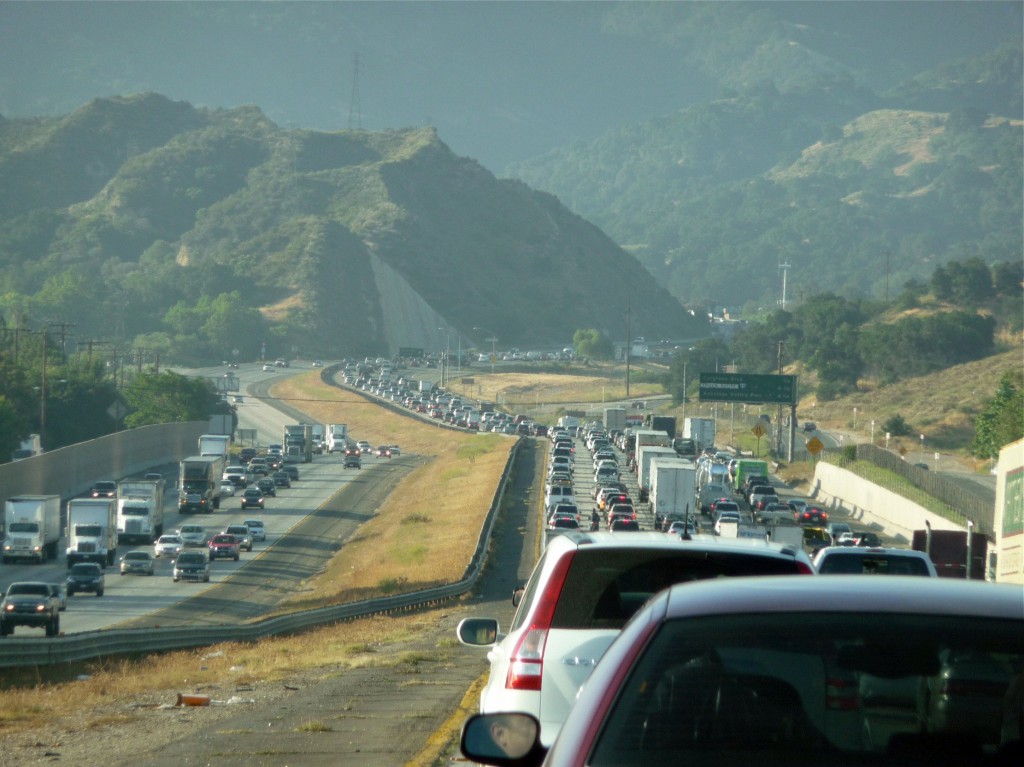
Newhall Pass image courtesy of Flickr

So the Signal is really proud of the work that’s being done on the Newhall Pass that will lead (ultimately) to a faster commute for individuals and trucks heading south and north through our local mountain range. I am too.

But, as usual, they ignore anything that isn’t pro-business, namely, air quality and the cost all this transportation on the 5 through the Newhall pass imposes on us SCVers. Sure, when I say cost, you think of $$$, and the truth is we as California taxpayers are paying for this expansion with our wallets and income, but we as SCVers are paying for this expansion in another special way.

Let me explain.

We as a society want to encourage commerce, trade, and transportation as much as possible. But when those activities pollute our air, water, or soil, economists have a term they like to use: negative externalities. Basically it means that these activities are imposing an unmet cost on us, the regular citizens affected by the commerce, trade, and transportation.

Such is the case with the expansion of truck and car lanes in the Newhall Pass. The trucks and commerce the I-5 Gateway Coalition wants to traverse our valley impose an unmet cost on us as Santa Clarita Valley residents. It’s a cost the Signal is apparently completely oblivious to in its joyful praise for more lanes, more trucks, and a “damn the lazy government workers” editorial. Increased truck traffic will have a negative effect on us, namely increased ozone, particulate and noise pollution.

It may sound like I’m making much ado about nothing. After all, most days, Santa Clarita’s skies are clear and blue. Our skies look nothing like the purple and orange skies that kept me from playing outside when I was a boy in LA in the 1980s. But the threat is real and is there nonetheless as ozone and particulate matter are largely invisible, and with increased freeway traffic, the cost on our community will only go up.

Ozone pollution is the most worrisome. At high altitudes, ozone gases block much of the sun’s harmful rays. But closer to the surface of the earth, the effect on human lungs is consistent with a sunburn on our skin. Studies have found even low levels of ozone decrease lifespan. Ozone gases are definitely not good to breathe in. Here I quote from an environmental engineer at the City I talked with in 2008:

It’s good when ozone is in our upper atmosphere shielding us from UV radiation, but at the ground its harmful.  It essentially sunburns your lungs.  It gets worse on hot summer afternoons, and we also have a weekend effect where the ozone tends to get worse on the weekend afternoons.

It’s a matter of numbers.  A lot of cars, trucks and equipment burning fossil fuel in those areas creating emissions. The prevailing winds of the area blow the pollution this way. Ozone needs Oxides of nitrogen (NOx) and volatile organic compounds (VOCs), and both are created mostly from cars
and trucks.

These two pollutants react faster and faster with more sunlight and heat.  So the NOx and VOC migrate up the 5 freeway mostly, and somewhat less along the 126 from Ventura and Santa Barbara.  During the long, hot days of summer, we get a lot more ozone.

So as our lanes are expanded, more trucks and commerce come to depend on our valley and the Newhall Pass to deliver their goods. Thanks to the expanded 5 and the unique topography of our valley, pollution inevitably increases. The question is, who pays for that pollution?  All day long these trucks traverse our valley, depositing ozone gases and particulate matter in our air, and then they leave, essentially polluting our air for free.

That’s a cost on you and on me. It may be hidden now, it may not impact your wallet today or on tax day, and it may not manifest itself for a few (or many years), but it will nonetheless cost us in the future. To put it another way, what dollar amount do you place on your healthy lungs?

When the Signal refuses to acknowledge such cost and only looks at the decreased commute times to individual motorists, it does us all a disservice.

I-5 Expansion comes with an unmet cost

Comments (27)

  1. SFC PerezJanuary 10, 2011 at 3:15 pm
    Get ready to be called an environmentalist hippy Jeff, but not by me, I agree with you 110%! We don’t realize our actions have reactions and not all of them are beneficial. We also don’t realize that this planet and country aren’t ours to rape and pillage. There needs to be an open approach to finding alternative means to energy other then burn this and burn that creating a toxic environment for our future generations. Just because we can doesn’t mean we should.
  2. drive66January 10, 2011 at 3:30 pm
    Environmentalist hippy.
  3. ToddJanuary 10, 2011 at 3:39 pm
    Jeff, I agree with you in part. With our particular stretch, I don’t believe a larger, wider freeway means more cars. I believe commerce and development of rural areas lead to that. A less congested freeway, in my hypothesis, leads to less idling and less pollutants. The focus should be cleaner and more reliable transportation to serve the growing commerce and population.
  4. David KJanuary 10, 2011 at 10:15 pm
    Have you heard of induced demand? Wider freeways lead to commerce and development, not the other way around. It is an endless cycle that only leads to more sprawl without reducing traffic in the long run. When a freeway is built to a rural area it reduces commute times to jobs in the city, allowing people to live in the cheap rural area. This results in housing being built, and the rural area becomes suburban. As more people move to the cheap housing in the suburb it increases congestion on the freeway, which results in the freeway being widened. Initially, the supply of freeway capacity is far greater than the demand by commuters, and congestion is reduced. However this only results in more housing being built and more commuters during rush hour as people react to the excess supply of freeway capacity. Repeat this as many times as you wish. This is an endless cycle and you cant solve the problem by adding more lanes. For a current example, since SCV is built up, widening the 5 and 14 creates capacity and reduces commute times to the Antelope Valley and the future Tejon Ranch. More people will be willing to move to the cheap housing, because the commute times to the San Fernando Valley and points south will be less than it is today. The freeway improvements that are designed to help today’s commuters cannot and will not fix the traffic problem indefinitely.
  5. Leon WordenJanuary 11, 2011 at 3:36 am
    Huh? I-5 is not a freeway through a rural area. Sure, some areas along it may be rural, but …. I-5 is one of our nation’s biggest, most important, strategic federal interstate highways. No doubt it is a significant terrorist target, because you know what happens to commerce in the western United States when you take it out of commission. The building-a-road-through-a-rural-area-to-induce-growth argument is a non-sequitur in this instance. What I still want to know is, considering its strategic importance as a major federal interstate highway, why are state taxpayers footing the entire bill — or 95+ percent of it, anyway — and not the feds?
  6. JaneJanuary 10, 2011 at 3:41 pm
    Try living across the street from a guy who brings his semi home at night. Why the city can’t stop him from violating MuniCode is beyond me.
  7. spineflower2January 10, 2011 at 3:59 pm
    Parking right up against the truck’s front and rear, trapping him, would be perfectly legal. I would never advocate vandalism on a parked truck, even an illegally parked truck. Nossirree, that would be wrong. Are you in City limits, or an unincorporated area? I always had good luck with the CHP outside City limits getting rid of the trucks.
  8. ThomasJanuary 10, 2011 at 7:44 pm
    This worked for me about 8 years ago after moving into my house. The dumptrucks with the two trailers would park on my street and leave one trailer while they went up the street to dump dirt in the unfinished phases of the development. One driver would always leave the rear trailer in front of my driveway while he went up with the first load. One day after he went up the street, I parked my truck in front of his trailer just enough to wear he couldn’t swing the hitch out. He, along with the foreman knocked on my door and asked me to move. After the drive became angry and said he could park anywhere, I didn’t move my truck. He called the Sheriff’s and they impounded his trailer for blocking my driveway. After that no trucks parked on my street and the foreman had them park in guess what…….the construction area. Sorry for the long post.
  9. spineflower2January 10, 2011 at 3:56 pm
    Most of our smog doens’t come from traffic in the SCV or Newhall Pass, but from the SFV and LA. Prevailing winds blow it here. Even a total building moratorium in the SCV will not change that. In fact, by allowing free-flowing traffic, instead on low speed stop-and-go, pollution is lessened.
  10. ToddJanuary 10, 2011 at 6:04 pm
    @spineflower I’m not sure you’re correct about that. I believe that Burbank and Glendale get the brunt of the SFV’s smog via breeze. Because the smog is captured in the inversion layer, it usually gets held up by the mountains (which is Burbank/Glendale’s problem). Our own smog can be blamed on the commuters (both locally originated and just passing through), the commercial traffic on the 5 and the fact that you have to drive all the way across town to get to most decent stores and what few jobs we have here.
  11. spineflower2January 11, 2011 at 9:13 am
    From the Daily News back in 2003: At a meeting in Diamond Bar today, AQMD officials are scheduled to discuss regional plans to cut pollutants in half by 2010. If the smog-cutting goals are not achieved, the region could face a freeze on transportation dollars, as well as fees on businesses. However, officials have said the battle is difficult because AQMD only has jurisdiction over about 20 percent of the pollution sources in the Los Angeles Basin The Los Angeles Basin is the coastal sediment-filled plain located between the peninsular and transverse ranges in southern California in the United States containing the central part of the city of Los Angeles as well as its southern and southeastern suburbs (both in Los Angeles . The remaining 80 percent is in the hands of state and federal agencies, which have been reluctant to impose tighter pollution controls on cars, seaports and consumer products. Worse yet for the Santa Clarita Valley pollution experts say the bulk of the valley’s smog problems are caused by polluters in the Los Angeles Basin. The valley, described by some as an “air pollution cul-de-sac,” captures the smog drift from the entire basin. Another Daily News article in 2005 stated that according to the 2004 AQMD stuay: The study completed in November 2004 confirmed that the layer of smog that hangs above the Santa Clarita Valley is mostly generated by San Fernando and Los Angeles traffic , which is swept in by easterly ocean winds. Local emissions contribute to about 2 percent of the ozone and 10 percent of particulate pollution.
  12. Leon WordenJanuary 10, 2011 at 6:21 pm
    20 years ago there were 50 million annual vehicle trips on I-5 through the SCV. Today there are 73 million annual vehicle trips. (And another 60 million or so on the 14, versus 45 million 20 years ago.) Sticking our heads in the sand and pretending they won’t come if we don’t add lanes is silly. In theory, the longer trucks (and other vehicles) sit in stalled traffic, the more noxious chemicals they spew into our air. The quicker they traverse our valley, the less bad stuff they spew. We should move them through our valley as quickly as possible, which means more traffic lanes. Because they won’t stop coming — and multiplying. If you have a problem with The Signal supporting the last remaining businesses that haven’t yet been driven out of California, well then, I guess you’ve got a problem!
  13. NickelDimeJanuary 10, 2011 at 7:51 pm
    Mixed emotions. If we get an HOV lane as promised that extends to/through Tejon, this is a ‘good with the bad.’ Outside of that, it’s a band-aid. Car-based transport doesn’t easily scale.
  14. Coastal SageJanuary 10, 2011 at 9:44 pm
    On the issue of creating roads for long haul trips through Santa Clarita, an old, proposed road from the days of former City manager George-Caravalho has been raised as a potential contruction project again. Think of Magic Mountain Parkway heading from the 5 Freeway, across the west side of Santa Clarita, past McBean, past Valencia Boulevard, to where it dead ends at Railroad Avenue north of the Saugus Cafe. Originally, the owner of the Porta Bella project was supposed to build a bridge to lift an extended version of Magic Mountain Parkway from its current terminus up to the mesa above and east of what was Keysor Century plant, crossing both Railroad Ave. (which was then called San Fernando Road or Bouquet Canyon), the train tracks and the Keysor Century land. Once in the Whittaker Bermite property, the road was supposed to swivel through Porta Bella, meeting up with Via Princessa at some point. In the early 2000′s everyone said the proposed road was not going to be built because: (1) The bridge over the train tracks would necessitate a ramp which started way west of Railroad Avenue, and the developer could not afford it; (2) The bridge’s route was rumored to center punch the Saugus Cafe; and (3) The bridge crossing the train tracks would have to be approved by the California Public Utilities Commission, which would impose expensive design requirements. If I’ve forgotten additional reasons why the Magic Mountain bridge over the tracks was deemed infeasible, old timers should forgive me. So now, in the early 2010′s I’m hearing that completion of yet another cross-valley road, Magic Mountain Parkway, to bring traffic to and from the 14 Freeway, is being privately discussed by the powers-that-be again. However, this time it’s the public, not Porta Bella’s developer, who supposedly will pay for it. I’d be interested in any thoughts SCV Talk readers might have as to whether this new road is necessary, and for what purpose, given the volume of traffic on the Cross Valley Connector.
  15. ReaderMamaJanuary 10, 2011 at 10:16 pm
    Where will the public get the money to pay for it?
  16. ToddJanuary 10, 2011 at 11:26 pm
    Federal grants, Caltrans and MTA money would be the most likely sources of funding…. No way the City could pay for it themselves.
  17. SFC PerezJanuary 10, 2011 at 11:44 pm
    I was thinking overdue library book fines could fund it
  18. Need for Involved CitizenryJanuary 11, 2011 at 7:44 am
    Magic Mountain Parkway improvements under OVOV: Magic Mountain Parkway Between Long Canyon Road and Commerce Center Drive Construct new 4 lane Secondary Highway Between Commerce Center Drive and Westridge Parkway Construct new 6 lane Major Highway Between Westridge Parkway and Six Flags Magic Mountain Construct new 8 lane Major Highway Between Six Flags Magic Mountain and I-5 freeway Widen roadway from 4 lanes to an 8 lane Major Highway Between I-5 freeway and Auto Center Drive Re-stripe roadway from 6 lanes to 8 lanes Between Auto Center Drive and Valencia Boulevard Widen roadway from 4 lanes to an 8 lane Major Highway Between Valencia Boulevard and Railroad Avenue Re-stripe roadway from 4 lanes to 6 lanes Between Railroad Avenue and Via Princessa Construct new 6 lane Major Highway Where will the money come from? Will this be an at grade crossing? Where is the funding plan for all the roadway improvements under OVOV?
  19. Bill ReynoldsJanuary 11, 2011 at 5:58 am
    If only we had more high density development then more automobiles could be added to I-5, unless of course the State added bike lanes.
  20. Need for Involved CitizenryJanuary 11, 2011 at 7:26 am
    The widening of I-5 is a critical component under OVOV and is necessary to keep the traffic conditions from being at failing levels. But even without that, I’m sure they would say failing is OK in order to double the population – as they are doing with SR-14 which will be at failing levels through the SCV under OVOV.
  21. CastaicClayJanuary 11, 2011 at 8:18 am
    Let’s cover the Freeway with something made from recycled material and filter the “smog” out before it is released.
  22. spineflower2January 11, 2011 at 10:04 am
    How do you get enough oxygen inside?
  23. CastaicClayJanuary 11, 2011 at 12:31 pm
    Fans
  24. spineflower2January 12, 2011 at 9:22 am
    Anyone remember…? Eileen Anderson, L.A.’s perpetual singing candidate of a quarter-century ago, who warbled her proposals, such as a plan to disperse the smog with giant fans: Dig a hole in the mountains Put a tunnel through Put some wind behind it And blow some fresh air through Blow away the smoggy-og-og Yeah, yeah, yeah.
  25. spineflower2January 11, 2011 at 10:04 am
    If you want to get rid of truck traffic in the SCV, support the “Metropolitan Bypass Freeway” or highway (a dream from the 1960s) which would run along the 138 from I-5 west to I-15. Takes trucks to the railways in Fontana or thereabouts without going through the SCV/SFV/Downtown LA. Make Tejon Ranch pay for it.
  26. cashJanuary 11, 2011 at 11:41 am
    Seems we need to repair our existing freeways before money is spent on a Gateway. The Gateway is a pipe dream in this economy, along with the high speed rail system. Had our govenment not thrown money down a rat hole for so many years, perhaps we could afford what is really need. We’re broke people.
  27. LindaJanuary 11, 2011 at 2:24 pm
    Amen.

Preserved as part of the SCV Talk Archive. Text is presented as originally published; presentation has been standardised for readability. The original capture is available at the Internet Archive.

Support