
One of the things that angers me about today's liberals is their seeming inability to counter populist Republican notions with well-accepted economic truths that are easy to understand.
Take for instance the GOP's oft-repeated prescription to boost our economy: We must get government out of the way/make government smaller so/unleash the creative potential of the private sector! In one deft move, they cheer freedom (which everyone loves!) and boo government and liberty-loathing regulators. It's quite effective.
So how should liberals respond? Well every time a conservative makes this charge, we ought to reply with our own charge, that the government wouldn't have to step in if the marketplace didn't fail so often. Couple market failure with the resulting costs imposed on all of us, and you've got yourself a powerful answer to the "free market rules!" crowd.
 Here's an example: if the free market is so great, why does it fail to provide affordable health insurance to 40 or 50 million Americans? Insurers are free to create packages and programs that meet the needs of their customers, so how come nearly 1 in 6 Americans can't or won't access them, or get dropped by insurers when a critical need arises? Many of these Americans end up using emergency rooms for health services, which costs us all. Hence the drive for a federal program to address this failure.
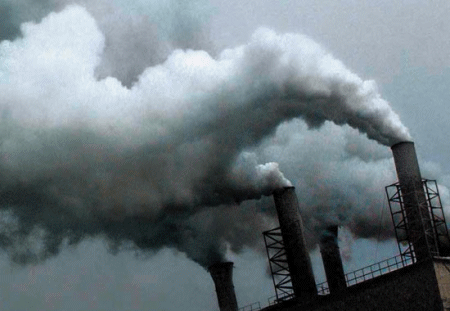
Or, let's take the topic of reducing air or water pollution, a subject most Americans would agree with. Air pollution is another example of a market failure; a person or company, exercising their freedom in the market, burns fuel to keep warm/drive/transport/ship something. But this activity results in pollution that settles into communities and is breathed by individuals who were not party to the emitter's activities. In effect, the polluter is imposing a cost on you and me without our consent.The free marketer doesn't have an answer for what is in effect a tax on the rest of us when emitters pollute a public good, like air or water.
A final example would be what is technically known as information asymmetry. Underlying a lot of free market principles is the idea that the buyer and seller will have the same information on a given product or service. They then agree on a price and a transaction is executed that benefits both parties. But what if the buyer doesn't have access to information the seller has? In most cases, not much, but in some cases, the results for the buyer (you and me) are extreme and devastating. I bet those Enron employees who were depending entirely on their Enron-backed 401k would have liked to have known their firm was about to implode in an accounting scandal in October 2001. The same goes for investors who were sold assets and securities by banks who knew their product was junk. In the former case, the government stepped in to ameliorate the market failure by creating Sarbanes-Oxley; in the latter, the government created Dodd-Frank. Both were in reaction to information asymmetry.
In this country we always let the private markets take a wack at solving problems first. If there is a need, surely the innovation, agility, and creativity of the market can find a way to fix it. But sometimes the market fails, and people lose everything, get sick, or are hoodwinked out of their money. In those situations, it is right for the government to step in and limit the freedom of agents in the marketplace. These aren't difficult concepts and liberals should argue them persuasively and passionately to counter conservative claims that government has overreached.
Advice for liberals
Take for instance the GOP's oft-repeated prescription to boost our economy: We must get government out of the way/make government smaller so/unleash the creative potential of the private sector! In one deft move, they cheer freedom (which everyone loves!) and boo government and liberty-loathing regulators. It's quite effective.
So how should liberals respond? Well every time a conservative makes this charge, we ought to reply with our own charge, that the government wouldn't have to step in if the marketplace didn't fail so often. Couple market failure with the resulting costs imposed on all of us, and you've got yourself a powerful answer to the "free market rules!" crowd.

A final example would be what is technically known as information asymmetry. Underlying a lot of free market principles is the idea that the buyer and seller will have the same information on a given product or service. They then agree on a price and a transaction is executed that benefits both parties. But what if the buyer doesn't have access to information the seller has? In most cases, not much, but in some cases, the results for the buyer (you and me) are extreme and devastating. I bet those Enron employees who were depending entirely on their Enron-backed 401k would have liked to have known their firm was about to implode in an accounting scandal in October 2001. The same goes for investors who were sold assets and securities by banks who knew their product was junk. In the former case, the government stepped in to ameliorate the market failure by creating Sarbanes-Oxley; in the latter, the government created Dodd-Frank. Both were in reaction to information asymmetry.
In this country we always let the private markets take a wack at solving problems first. If there is a need, surely the innovation, agility, and creativity of the market can find a way to fix it. But sometimes the market fails, and people lose everything, get sick, or are hoodwinked out of their money. In those situations, it is right for the government to step in and limit the freedom of agents in the marketplace. These aren't difficult concepts and liberals should argue them persuasively and passionately to counter conservative claims that government has overreached.